Sunday, August 10, 2008

Montserrat

Today a group of us went to visit Montserrat. We took the Funicular de Sant Joan to take us to the top of the mountain (about 2,400 feet above sea level) where there are various abandoned hovels in the cliff faces that were previously the abodes of reclusive monks. Montserrat, with its unique rock formations, dramatic mountain monastery, and connection with the Catalan people and their struggles, is a very important pilgrimage site for Catalunya.


Thursday, August 07, 2008

News segments on EVA dive

So we were able to find that clip from someone else that was interviewed from my group. You can see me in the background and we are also the group that is being shot underwater!

Here is the link: http://www.tv3.cat/videos/582229

Also yesterday, another department had their rocket launches and they were featured in the news as well!

Here are the links to the videos: Video 1 and Video 2

Talking with the media during "our EVA"

Some students mentioned that they saw me on the local TV station from when I was interviewed at the pool when we were doing our simulated EVA under water.

I didn't get a chance to see it on TV, but someone was able to get these photos of me. :)

Tuesday, August 05, 2008

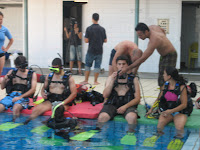
Simulated EVA...underwater


This afternoon we went to a deep pool to do a SCUBA dive. We simulated an EVA as we were each divided in groups of four with certain roles and tasks. Our scenario was to fix a broken sensor on the Hubble Space Telescope. One person had very thick insulated gloves and had to unscrew certain segments with tooling. Another team member had to replace the sensor. One person was in charge in distributing the correct tools and making sure the tools stayed in the bag. I was in charge of making sure the procedures were carried out as required. We had a waterproof procedure sheet that we took with us and I was in change making sure our procedures were carried out as required and that the assigned person was performing the task. Our group communicated so well and did a great job at team work. We did an awesome job in communicating with hand signals since we couldn´t talk to each other. I was also inteviewed by a Spanish television station; BarcelonaTV. They interviewed me at the pool to talk about the ISU program, the dive, and about applying for the astronaut candidate program.

Sunday, August 03, 2008

Space Masquerade Ball and Sunday Stroll

Last night, we had a space masquerade ball. A group of us did a group costume theme where I was the Sun, someone else was my solar wind, and 8 bits with 1 error (due to the solar wind electromagnetic radiation). Purely embarassing for me to dress up like this...but I think it was pretty creative. :)


Today we had a full day off so I did a little walking around Barcelona. The group got a good group rate at the University of Barcelona gym so when I got back I swam some laps in the outdoor pool. It was definitely a way to cool down from the heat. :)

Thursday, July 31, 2008

Visit with Astronaut Michael Gernhardt

Today in the Life Sciences Department, Astronaut Michael Gernhardt presented some absolutely awesome things he's been working on. He's the founder of Oceaneering Space Systems, a professional deep see diver, and currently NASA's lead for extravehicular physiology systems and performance projects. He gave us a great insight on his design for Small Pressurized Rovers (SPR) to be utilized for astronauts to explore the Moon's surface. I couldn't find a picture of the most updated conceptual design as he showed in his presentation today, but this is what an older design looks like: photo

He also brought in an EVA glove and older astronaut suit helmet that I just had to try on. :)

Wednesday, July 30, 2008

Week 5 at ISU

We all just arrived back to Barcelona from Madrid and checked-in to our new residence. Unlike the last residence, this building does not have air conditioning and we're all feeling it. It's pretty hot even with the window open. Tommorrow I am going to try to at least get a fan in the room.

Today I visited INTA and they toured us around their Astrobiology Center and the hangar where they fabricate UAV prototypes. Security was pretty tight and they wouldn't allow us to take our camera past the security gate, so I was unable to take any photos. However, I really enjoyed the visit and all they are involved in.


My new room

Tuesday, July 29, 2008

A couple days in Madrid

Right after our exam we took a plane to Madrid. Today we had the opportunity to visit a center of the Eurpoean Space Agency (ESA). We visited the European Space Astronomy Center (ESAC). ESAC is a space science center located in Villanueva de la CaƱada and conducts the operations for space-telescope and planetary missions. This site also has a castle ruin from the 15th century. How cool is that?!


Tomorrow I will be attending a site visit to Instituto Nacional de Tecnica Aeroespacial, or the National Institute of Aerospace Technology (INTA). INTA is a public institution specializing in aeronautics and aerospace research and development.

Saturday, July 26, 2008

Study Break - Watching Fireworks Out My Window


I don't know what's being celebrated, but one thing that I love about being here in Barcelona is that I often get to see fireworks. This one was a good 15-minute display...and study break. :)

Friday, July 25, 2008

A Pretend-Doctor For An Afternoon!

Today we completed all of our core lectures. We have completed 62 lectures in total and on Monday we have a big 4-hour exam on all the material. This weekend is completely devoted to studying.

After the last lecture we attended our department activity. Today in the Life Sciences department we received a hands-on introduction to space medicine. To help us understand the type of medical issues that astronauts could face during a mission, we began by practicing sutures on pig foot lacerations. We had some doctors present to help us get the stitching technique down. I think I did pretty good on my pig foot. :)

We then moved on to measuring heart rate and blood pressure with a buddy. Lastly, we looked into cardiac anatomy. When we venture on to long-duration human spaceflight, it is conditions like understanding human physiology and knowing how to perform surgery in space that the crew will have to be trained for. After listening and engaging in the lectures and activities of the Space Life Sciences department, it has really peaked my interest in becoming involved in the medical field.


Wish me luck on the exam!!! After the exam on Monday, the group heads to Madrid for some site visits. :)

Thursday, July 24, 2008

Visit to Nuevas Tecnologias Espaciales (NTE)

The Life Sciences Department visited Nuevas Tecnologias Espaciales (NTE) today after the morning lectures. NTE is a small company that offers their expertise in the Space Life Sciences and Biomedical sectors.

Below is a picture of the Muscular Atrophy Research and Exercise System (MARES). MARES is developed by a consortia led by a company called Nuevas Tecnologias Espaciales (NTE). It is a strength measurement device for physiological research under microgravity conditions onboard the International Space Station (ISS). We were able to view the crew getting the qualifier model and flight model ready to send to NASA.

Wednesday, July 23, 2008

Visit to Lleida Airport Site

Today the students who will be writing a final report on the topic of Spaceports visited an airport construction site near Lleida. We will be creating a business plan specifically in this region to evaluate the location for a spaceport. Here are some pictures from today's visit.

The airport construction site!


With the Mayor of Lleida and the group of Spaceports!


The women of the group with the project co-chair..and me on the runway!


It's 1:28 am and we just got in from the bus ride back. It's definitely time for bed!

NASA has received my Astronaut Candidate Application

Someone was nice enough to scan what I received in the mail the other day back home. :)

Tuesday, July 22, 2008

Week 4 at ISU

Tomorrow we have three lectures and right after the third one, the Spaceports team (my team project) will be going on a site visit to a city called Lleida. A new airport is planned for the town of Alguaire. The sponsors of our spaceports project are also the ones who are working with the development of the new airport. There is a possibility that we may do a case study as part of our project on whether a spaceport at this location is feasible.

I have also been assigned to the Space Life Sciences department which I am very happy about. I really am interested in the human body effects and other aspects that space activities will have in the space environment. We also get to do a SCUBA diving activity to simulate an astronaut training activity.

On Monday, we had three working sessions where we played out a scenario that one of our team members was an astronaut with particular symptoms. We had the manual that they use on the ISS to diagnose certain conditions. We were able to determine what medicine was required and had to think of how to deal with the astronaut's condition in the space environment. Our astronaut ended up having a urinary track infection.

A very cool tool we were able to use was the Advanced Diagnostic Ultrasound in Microgravity (ADUM) software. In space, there are times that someone may require an ultrasound in order to further diagnose a condition. But since not everyone on the crew may be a doctor, this software helps the astronauts determine where to position the scanner and how to tilt it to get a better view of a particular body part. The astronauts practice with this software as well to understand the output of the ultrasound machine as well. The picture below show Commander Leroy Chiao performing the ADUM Bone Scan on the knee of Flight Engineer Salizhan Sharipov during Expedition 10.

Send your name to space!


Send you name to the Moon on board a Lunar Reconnaissance Orbiter
Website: http://lro.jhuapl.edu/NameToMoon/index.php
(Deadline is July 25, 2008)

The Lunar Reconnaissance Orbiter (LRO) is the first mission in NASA's Vision for Space Exploration, a plan to return to the moon and then to travel to Mars and beyond. LRO will launch no earlier than November 24, 2008 with the objectives to finding safe landing sites, locate potential resources, characterize the radiation environment, and demonstrate new technology.


Submit your name using the form at the following website and it will be stored on a DVD and rocketed into space on board the Kepler spacecraft!
Website: http://namesinspace.seti.org/
(Deadline is November 1, 2008)

Kepler is NASA's first mission capable of detecting Earth-size and smaller planets in the habitable zone of solar-like stars. The spacecraft is planned to be launched from Kennedy Space Center in February 2009. The spacecraft will be launched into orbit around the Sun, not the Earth, with an orbital period of 372 days. The spacecraft will slowly drift away from the Earth, such that in about 25 years it will be half an Earth orbit away, 300 million kilometers distant from the Earth, passing behind the Sun as viewed from Earth.

Friday, July 18, 2008

Galactic Suite: Space Resort

Yesterday, we visited the architectural center for Galactic Suite Limited. Galactic Suite is a planned space station intended for use as an orbital resort to be made operational in 2012. The 3-day stay will cost somewhere around $4 million per person. Included in the price is an 8-week intensive training course at a space camp on a tropic island. Velco will be available for the guests to stick to the walls around the hotel and showers are taken by entering a spa room filled with water bubbles. Space tourism is definitely increasing and there are people who are willing to pay this price. Check out there website: http://www.galacticsuite.com/

Here are some pictures of their design center:


And now I'd like to post a picture for some of my friends from ForumAstronautico.it as they may know Laura as well. It was a coincidence that we met at ISU and knew the same people.

Wednesday, July 16, 2008

Astronaut Panel and Ambiguous Figures!


Weekly, the students of ISU attend panels which include some distinguished guests from different countries and backgrounds on some pretty interesting topics. Last week we attended a panel which was about Europe and where they are with Space. Being so tied in with NASA and their direction on spaceflight, it was great to hear the European Space Agency initiatives. Last night, I attended a panel in which the audience had an interactive discussion with ESA Astronaut Pedro Duque from Spain, CSA Astronaut Robert Thirsk, and former US Astronaut Jeff Hoffman. The panel was on the next 20 years of human spaceflight. Some great questions were asked by the audience and I threw one in there too!

So this brings me to my next topic! On top of our lectures we had to provide a 1st, 2nd, and 3rd choice of some advanced electives. Today we found out what elective we were assigned to and I was assigned to one titled ISS Educational Activity. I only knew a little bit about the elective before I went into it, but I am more than excited now!! So here's the gist of it.

Astronaut Robert Thirsk will be heading to the ISS in May 2009 for a 6-month stay to help out Expedition 19/20. Astronaut Frank DeWinne also be joining him. They will leave onboard a Russian Soyuz (19S). With the help of Dr. Guilles Clement, a renowned neuroscientist, we will be proposing an educational project for Astronaut Thirsk and DeWinne to perform. Our project will be to determine the effect the space environment has on the astronauts when they view 2D and 3D ambiguous figures. What are ambiguous figures? Figures that allow for more than one perceptual interpretation, each of which is accurate. So we need to fine-tune a software that will present the figures and record data they are selecting, develop crew procedures, and complete some other documentation by the end of the month. We're a team of about 15 students, and it is intended to have the ISU students of next summer interpret the data. Now, we're not certain that our project will get approved, but there is a pretty good chance. Today, Astronaut Thrisk and Dr. Guilles Clement were helping us in answering questions and listening to our suggestions. We're making good progress and I think we can definitely finish by the end of the month! Here are a couple of ambiguous figures that are pretty common:

Do the images change for you? How often does the image change for you?


The brain, and not the eye is the true organ of visual perception. In each of the illustrations, notice how difficult it is to see both images simultaneously. This difficulty arises because your perceptual system prefers to make only one interpretation at a time. Go brain power! :)

Monday, July 14, 2008

Update on Astronaut Candidate Selection Process

I have a friend who recently attended a NASA conference and had a chance to meet with someone who knew a little of what is to come of the astronaut candidate selection process. Please keep in mind that I have not seen this officially released by NASA anywhere, but it at least provides an overview with some tentative dates. I just wanted to share this with everyone as I know there are many people out there who have applied this round and are probably wondering what happens next.

August 2008/September 2008
Initial application review
1st sweep to disqualify initial applicants just based on application information

October 2008
A couple hundred applicants asked to visit JSC
Two groups
Group 1: Mon – Wed
Group 2: Wed – Fri
Social event scheduled for Wednesday
Anthropometric measurements (need to meet Soyuz standards)
Panel interviews (7-9 people in the panel)

February/March 2009
Only about 40 applicants selected for 2nd visit
Two groups for week long medical (one group during one week and another group during a different week)
Full body MRI
Hearing
Vision
CAT scan
EKG
Colonoscopy
Blood work, etc.
The final candidate group will be selected a couple of months after the final medical results.